
Tracklaying to me feels like a military campaign — an awful lot of stuff has to be planned out so that it all comes together in the end. There’s no single session to get it done in — it can be weeks (even months) before a significant portion of the new track work is done and ready to operate.
The next section to work on will be the Produce District. This is still in the northern portion of the railroad (where the dividing line is the Ferry Building at the foot of Market Street). Much of this is the section shown in this fantastic picture. This is just around the corner on my layout (I know, I really should come up with a drawing/diagram of how all of this fits into the basement), and is to be operated from an aisle opposite the aisle for the existing area (North Point & Pier 29). This means that there’s much more room on the benchwork for the industries, warehouse, and tracks inland from The Embarcadero, and no room for the piers.
So what makes this a campaign?
Well, given the lack of AC in the basement, I don’t like to lay track in the summer (or even until after the mid-fall change to much dryer air). But that doesn’t mean that I can’t do anything.
First, I knew that the long L-girder along the wall side of the peninsula where the next district will be was right above where the main tracks will be, the ones running alongside The Embarcadero. There was insufficient room for the Tortoise switch machines that I like to use. And even switching to some lower profile switch motor would have been difficult given the lack of clearance to move around in.
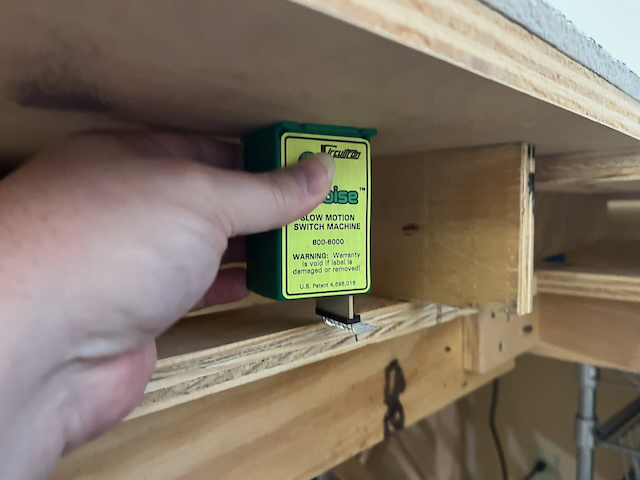
I didn’t have enough support readily at hand to hold up the entire side of the layout (about 26′ long) to lower the existing girder. So I made a new girder, installed it below the existing piece, and then built up new risers to support each of the cross members, and then removed the original girder. I’ve known for years that I needed to do this, and it always felt like a major undertaking. Yet, from start to finish was no more than a week’s worth of evenings.
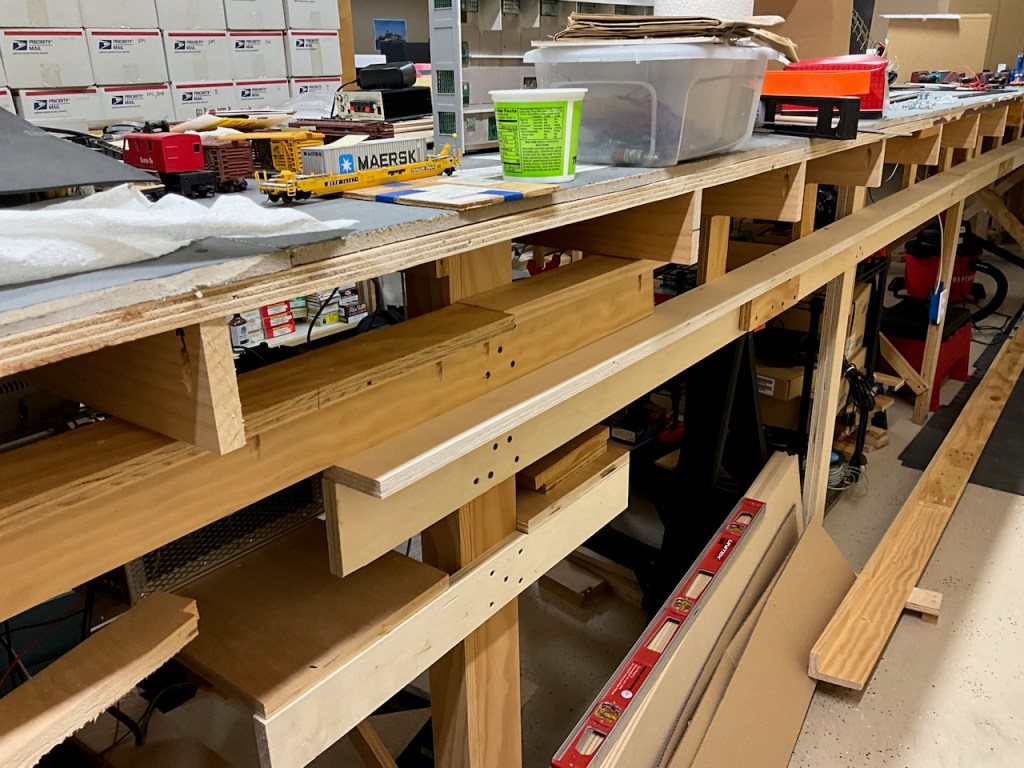
Here’s the new girder in place (the old one is on the floor). Now there’s much more room to install the switch machines. The end-most couple of feet of the old girder remained, for clearance of a bookshelf at the very end and because that last bit won’t need the turnouts right up front, as this is where the King Street SP interchange tracks will be.
Then came time to tackle the cabling mess. I’ve been accumulating all sorts of layout electronics over the years, and they’ve been on top of the benchwork for easy access. So the various cables all dangled over the edge of the layout. There are three DCC command stations in there (Digitrax DCS100, Pi-Sprog, and DCC-EX), two Raspberry Pi’s for various things, mostly JMRI interfaces to said command stations, main and programming track connectors (all using the Anderson PowerPole interfaces made popular by the FreeMo folks).

So I built a shelf under the layout (it was easily accessible now because I had to move things around to add all of the new cross-member risers from the new L-girder) and put all of the electronics bits underneath. In all of the re-arrangement I switched my primary control system to the DCC-EX based command station. Programming is done with the Pi-Sprog. The Digitrax system is kept around for backup purposes and for testing & comparison purposes. I can switch the State Belt between any of these three systems in about 5 minutes, half of which will be restarting JMRI with the proper interface selected.
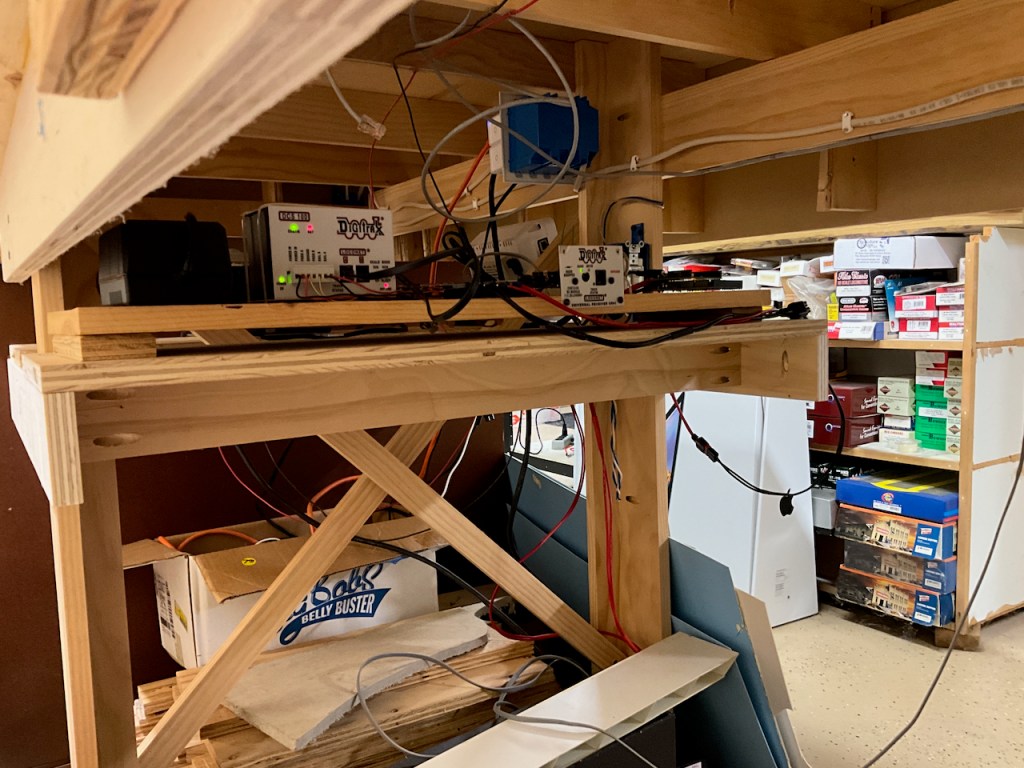
With a hole drilled through the sub-roadbed for the programming track connection, all of the cabling is now below grade and the railroad now looks much cleaner. That last cable hanging down is just because I haven’t cleaned up that section of the benchwork yet. But look at all of the crap on the benchwork. Okay, that’s got to go now too. Time to pick things up. Alas, no picture exists of clean benchwork.
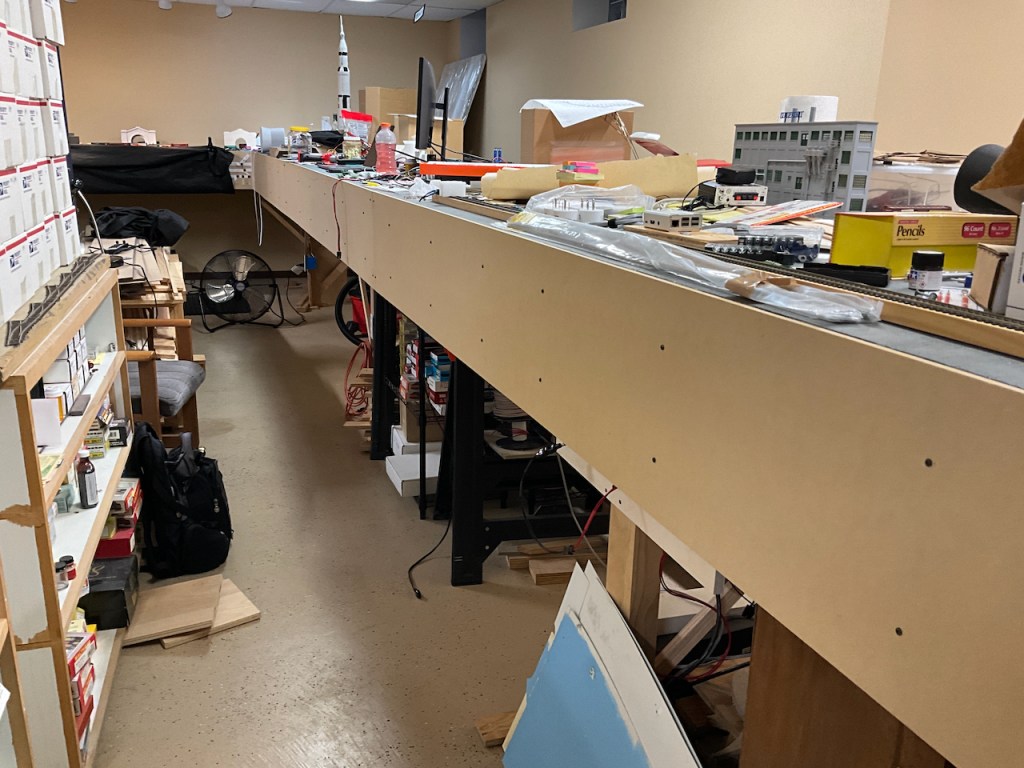
Next, I’ve been laying out a street grid, and building some (semi) temporary1 building mockups to represent some notion of what the urban infrastructure here looks like, at least in the things that concern the operations. What will the view lines be across the tracks to the buildings beyond? What level of compression still manages to look right? How reachable will things be?
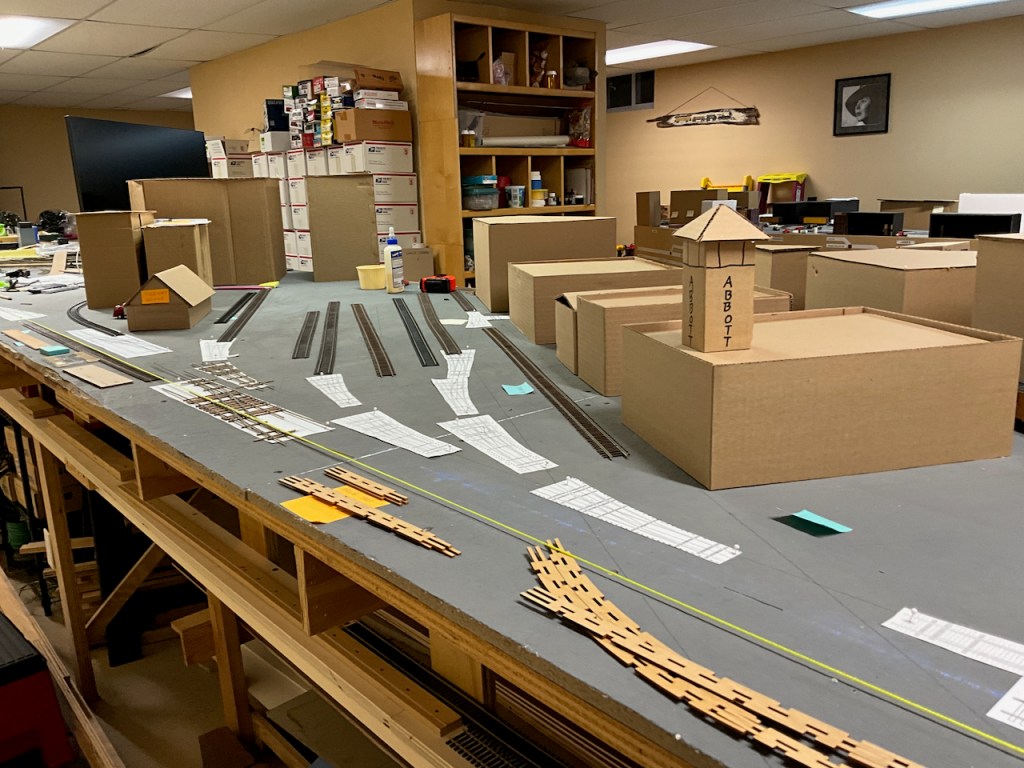
So this picture represents a vague idea of what the new section will look like. Several team tracks in the middle, spanning multiple blocks each. “Traditional” street trackage alongside the adjoining row of buildings, and some more spurs heading inland on the right hand side (and off the edge of the photo).
So what else do I need to do before I can get started?
Check with the Quartermaster, since every campaign will succeed or fail on the logistics. Whoops, my coffee can of ties is nearly empty. Whoops, my stash of rail is low. Gotta replenish those before I can start in earnest.
And I haven’t even touched a bit of track yet.
More to come soon.
- The U of Minnesota built a bunch of “Temporary” buildings in the influx of students just after World War 2. The last one was finally taken down a couple of years AFTER I started in the mid 1980’s. “Temporary North of Appleby”: you will not be missed. ↩︎
 Building the State Belt Railway